
Sozialstadtplan Bremen
Case · Non-Profit & SocialAbout the project
The Sozialstadtplan Bremen is a guide to aid services in Bremen, bringing together support from different organisations and faith groups – soup kitchens, emergency shelters, clothing banks, counselling centres, cold-weather buses, drinking-water fountains. Diakonie Bremen has published it since 2020; together with appfarms it was rebuilt in 2024/25 as an offline-capable, multilingual Progressive Web App, funded by donations from the Wilhelm Kaisen Bürgermahl.
For us the brief was clear: software meant to reach people in need has to work where internet, devices and time are scarce. We designed the architecture and tech stack around exactly that.

Live at sozialstadtplan.de – as an installable Progressive Web App for iOS, Android and desktop. No app store, no sign-up, no account: open, add to home screen, done.
A look inside the app
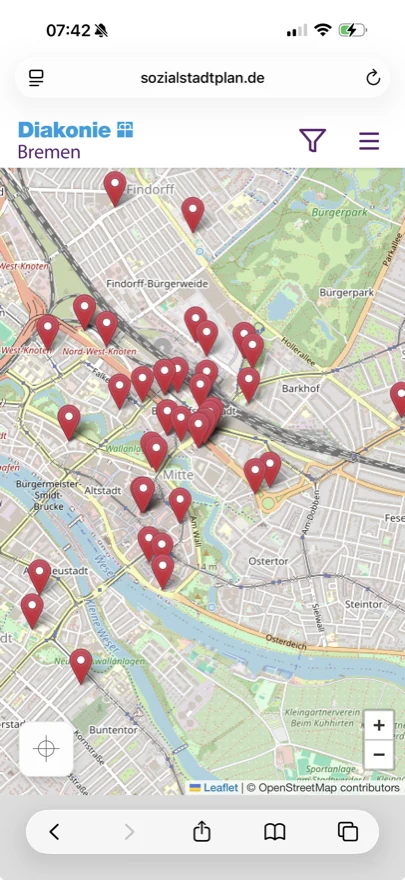
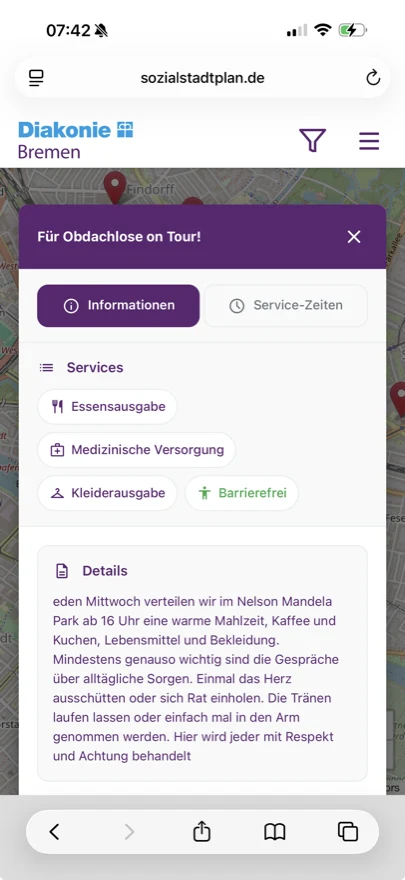
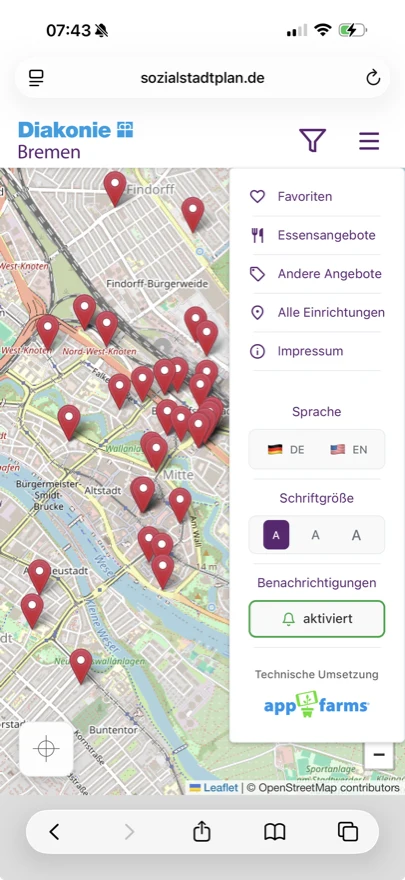
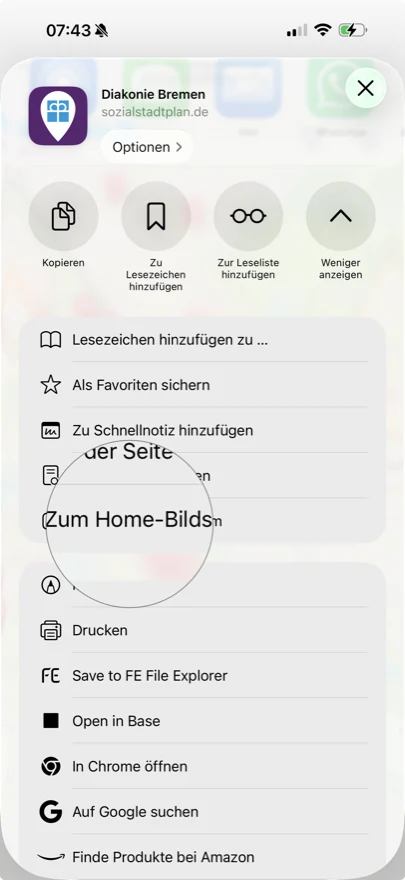
Press & background
- Weser-Kurier – Bremer Sozialstadtplan listet detailliert Hilfsangebote auf (German)
- Weser-Kurier – Ob Essen oder Beratung: Der Bremer Sozialstadtplan zeigt Hilfen auf (German)
- Bremen Senate – Support services for people in need (cabinet document, 23 Jan 2024, PDF) (German)
- Diakonie Bremen – Sozialstadtplan: a digital guide to social services (German)
- Diakonie Bremen – Sozialstadtplan Bremen – a guide to social services (German)
- www.sozialstadtplan.de – the live application
Challenge
People experiencing homelessness or poverty in Bremen need easy access to support. Numerous aid services exist, but they are hard to find for those who need them. The original Sozialstadtplan only existed as a printed brochure – difficult to keep up to date and of limited use to people without a fixed address or stable data plan. The brief: a digital solution that works without reliable internet, on older devices, and in more than one language.
Solution
appfarms built the Sozialstadtplan as a Progressive Web App – installable like a native app, with a service worker for offline use and a lightweight map engine that runs smoothly on older hardware. A proximity search surfaces aid services within walking distance, an English version lowers the language barrier for refugees and tourists in need. An editorial CMS lets the Diakonie team manage services, opening hours and seasonal closures (such as public holidays) on their own – no developer involvement required.
Outcome
The digital Sozialstadtplan was introduced with a supporting communications campaign. Across providers and denominations, it lists more than 100 aid services – from soup kitchens and emergency shelters to medical care. Social workers also use it as a daily tool. The print version remains in place and is fed from the same CMS. appfarms delivered parts of the project pro bono – to help people in need in Bremen.
“With the digital Sozialstadtplan we make it faster and easier for homeless and low-income people – and everyone supporting them – to find the social services Bremen has to offer.”
Translated from German.
Frequently asked questions
What is a Progressive Web App (PWA) and why was it the right fit?
A PWA behaves like a native app – installable on the home screen and usable offline – without the friction of an app store. A perfect fit for an audience for whom storage, mobile data and account sign-ups are often blockers.
How does the map work offline?
A service worker caches map tiles, aid-service data and the UI on the device. Previously cached content remains available without an internet connection, and updates are fetched in the background once connectivity is restored.
Who keeps the listings up to date?
The Diakonie Bremen team maintains services, opening hours, closures and editorial content via a CMS – without needing a developer. That keeps the data current.